
Posted by Happy Trails Medicinals on Jan 19th 2026
The Baird–Craig Extension and Why It Matters for Hemp in 2026
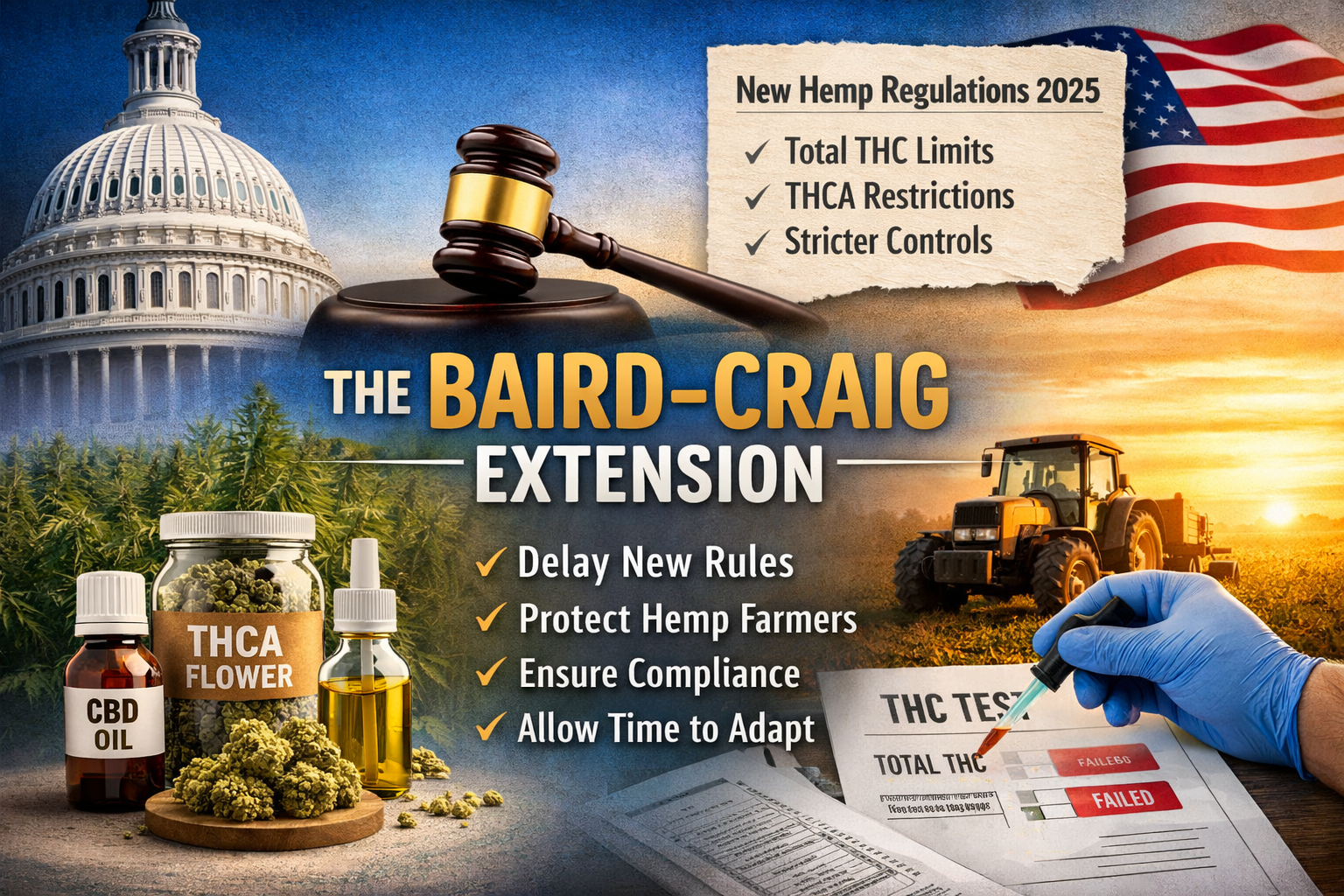
The Baird–Craig Extension: Why It Matters for Hemp in the New Federal “Total THC” Era
The hemp industry is operating in a fast-shifting federal environment. In late 2025, Congress amended federal hemp law through a government funding package, tightening definitions and limits in ways that directly impact THCA flower, delta-9 thresholds, and many hemp-derived cannabinoid products. A bipartisan effort commonly referred to as the Baird–Craig extension (a delay bill) seeks to push back implementation timelines so farmers, retailers, and regulators can adapt with clearer rules and less disruption.
What changed at the federal level
The 2018 Farm Bill framework largely focused on delta-9 THC concentration (0.3% on a dry-weight basis) as the defining line for “hemp.” The 2025 funding law shifted the conversation by adjusting the federal definition and adding new constraints aimed at intoxicating hemp products.
1) “Delta-9 only” moved toward “total THC”
Congressional analysis describes the 2025 law as revising the definition of hemp to reflect total THC rather than only delta-9 THC. This is a major issue for THCA products because THCA can convert to delta-9 THC when heated (smoked, vaped, or decarboxylated).
Source: Congressional Research Service (CRS) – Change to Federal Definition of Hemp (IN12620)
2) A finished-product THC cap became central
Legal and mainstream reporting on the 2025 funding bill also highlights a shift toward per-product THC limits—commonly reported as a 0.4 milligram total THC cap per finished product/container —alongside broader restrictions intended to close the “intoxicating hemp loophole.”
- Venable LLP – Federal Funding Bill Overhauls Hemp Definition, THC Cap
- The Washington Post – Congress tightens THC restrictions on hemp
Why THCA is specifically affected
Under a “delta-9-only” framework, many THCA flower products were marketed as compliant because delta-9 THC content measured below the threshold. A “total THC” approach treats THCA as relevant to compliance because it can convert to delta-9 THC with heat. That shifts what genetics are viable, how harvest windows are managed, and how risk is assessed across the supply chain.
Research/technical context: total THC calculations are commonly discussed in regulatory and lab contexts because THCA converts to delta-9 THC during decarboxylation (a well-established chemical process). For the federal definition shift, see the CRS summary above.
So what is the Baird–Craig “extension”?
The Baird–Craig extension refers to a bipartisan push—associated with Rep. Jim Baird (IN) and Rep. Angie Craig (MN)— to delay the effective date of the new federal hemp restrictions. Reporting in January 2026 describes the effort as buying additional time so the industry and lawmakers can pursue clearer, workable standards instead of a sudden compliance cliff.
- Forbes – New Bill In Congress Seeks To Postpone Hemp THC Ban
- ABC 6 (KAAL) – Rep. Angie Craig proposes delay to new hemp laws
- Marijuana Moment – Bill to delay federal hemp THC ban
Why supporting the extension matters (even for people who want tighter rules)
There are two separate issues: what the rules should be, and how fast they should take effect. A delay is about implementation stability—so policy, testing, and enforcement can align with real-world agricultural and retail timelines.
1) Farming and manufacturing run on long lead times
Planting decisions, biomass contracts, extraction schedules, packaging runs, and retail distribution plans are made months in advance. Sudden rule changes can strand inventory and destabilize legitimate operators—even those trying to comply.
2) Testing and definitions must be consistent to be enforceable
If “total THC” becomes the standard, the industry needs uniform expectations for sampling protocols, lab methods, and how regulators interpret product formats (flower vs. edibles vs. beverages). A transition period makes it possible to implement consistent standards instead of patchwork enforcement.
3) Consumer safety needs real standards, not just sudden prohibitions
Federal agencies have repeatedly raised concerns about adverse events and accidental ingestion—especially for edible products and intoxicating hemp derivatives like delta-8 THC. A transition period is where meaningful protections can be built: packaging standards, age gating, labeling accuracy, and contaminant testing.
- CDC HAN Advisory – Delta-8 THC availability and adverse events
- FDA – Accidental ingestion of THC edibles by children
- FDA – Adverse Event Reports Involving Delta-8 THC
What success looks like during a delay period
If the Baird–Craig delay effort advances, the “win” for hemp is not avoiding regulation—it’s creating a workable framework:
- Clear federal definitions that match chemistry and real-world product formats
- Uniform testing standards across labs and states
- Consumer safeguards (packaging, labeling, age gating, contaminant controls)
- Predictable timelines so farmers and businesses can plan and comply
Bottom line
The 2025 federal funding bill introduced stricter hemp language that reshapes how THCA and delta-9 are treated at the federal level. The Baird–Craig extension is fundamentally about stability and implementation runway—so compliance can become consistent, science-based, and enforceable without collapsing legitimate hemp activity overnight.
Suggested further reading:
Take Action: Support a Practical Transition for Hemp
If you support clear, enforceable hemp rules with a realistic implementation timeline, add your voice. This action page makes it easy to contact lawmakers and help stop a sudden hemp ban from taking effect before the industry can adapt.
✅ Support the Extension: Help Stop the Hemp BanTip: Share this link with growers, retailers, and customers—policy momentum is driven by volume and consistency.